Wednesday, February 29, 2012

Wismar UNESCO Heritage Museum

For the semester's Main Project, I chose the class in which we were to design the entire concept for a city heritage museum. The town of Wismar is a UNESCO heritage site in conjunction with Stralsund and this museum, which will be built in the next few years, would honor this prestigious recognition. The students of the class provided the city valuable design research towards architecture, architectural lighting, media content and landscape design.

Within a group of three, we were to create a presentation, posters as well as a booklet which would include all our content as well as our specified products and Dialux (light level) calculations. The following images are examples of the work I did for the group which provided as design consultation to the city.

Front Facade Lighting Concept

Rear Garden Lighting Concept

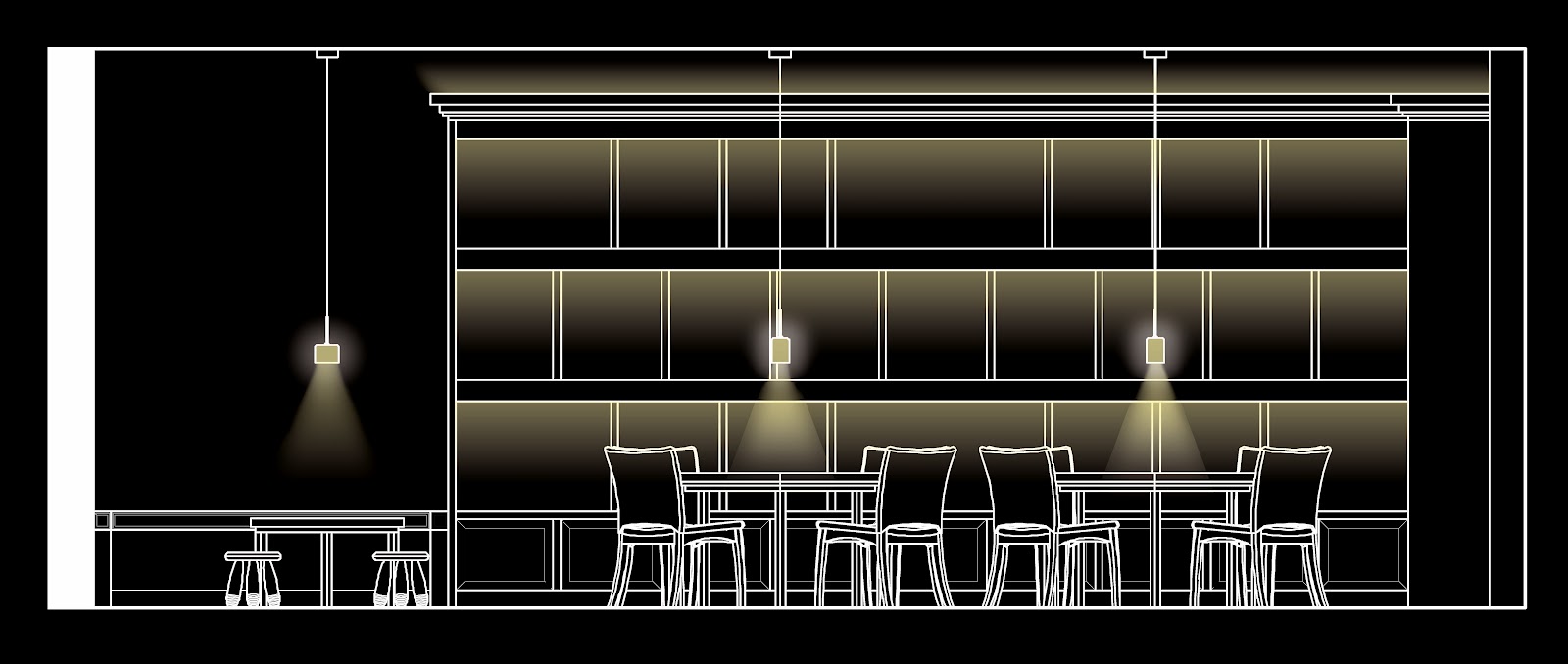
Cafe Lighting Concept

A0 Poster #1

A0 Poster #2

Neuruppin

For some years now, the students of the Masters of Architectural Lighting Design have had an opportunity to create an installation lighting event in the small town of Neuruppin. Neuruppin is a charming lakeside town just about an hour outside of Berlin in the state of Brandenburg. 

This year the students were to light the area around the Old Fisherman's Market which has been converted into a large playground, surrounded by beautiful old houses. The class was divided into three groups which took care of the lighting of a large play net, two wooden water play sculptures as well as a concrete bench and, lastly, the exterior facade of the surrounding area.

Our group consisted of the two wooden water play sculptures and the concrete bench. We wanted a subtle lighting scheme as to not overwhelm the viewers and to allow the play net to stand out as the feature element. For our concept, we reduced our lighting to warm and cool light, warm light to represent the sand, and cool light to represent the water.


  Photo Credit: Dwayne Waggoner

Light in a Box

Another assignment for the Fall Semester 2011 was to recreate an known architectural lighting scenario within a box with the dimensions 20cm high x 40cm wide x 80cm long.

For this assignment I decided to use a project I had already blogged about, the Limerick House Spa in Limerick, Ireland.

Here are some original images of the Limerick House Spa:


Following are images of my recreation of the lighting scenario using a box with the previously specified dimensions and various light sources. I attempted to produce multiple moods within the box by using various colors of light, turning sources on and off and using various materials, such as translucent paper and a mirror.


The project proved to be both interesting and quite helpful. By analyzing a case scenario to such great depth, I was capable of understanding what architectural and light elements provide what sort of feelings towards a space.

Leuchtschotten

For this project we were asked to design and build a lamp using various paper products and LED light sources. The lamps were to be on display in Grevesmühlen, a neighboring town of Wismar, within an old factory plant that processed malt and wheat for a brewery. We were encouraged to learn to wire our own LEDs and to create something that was fitting for the architecture of the space.
As the building used to be a factory for malt and wheat, I took inspiration from the shapes of grain pods found in such plants. I experimented drawing the shape of the pods three dimensionally in SketchUp.
After finalizing the shape of the pod, I then flattened the three dimensional shape to two dimensions using geometry. This then produced an image that would be printable and that I could then cut out and reform into the three dimensional pods I had created in SketchUp.
The above image is the two dimensional version of the printable "pod." I then printed these in various sizes and rebuilt them. Watch the video below to see a stop-motion version of me building these pods. Each pod took about an hour to cut and glue together. I created 18 of them for the final lamp.
video
After building all 18 of the pods, I then wired LEDS together and attached them to a base mount. Here are a few "behind the scenes" images as it started coming together.
After the LEDs were wired, the base was built, and the lights were attached, I could begin attaching the paper pods which worked as diffusers to the LED lights. Below are the photos for the final project.


I titled the piece "Leuchtshotten," which means Light Pods, in German. Finally, I placed the lamp in an old window frame arch within the building, which I thought served as an ironic showcase for the piece.
I enjoyed learning how to wire LEDs in this project. Looking back, however, I would have experimented more with building a piece that would have fit more specifically to the space, rather than making such a sculptural object.

One Semester Down, Three to Go

With the first semester successfully completed at Hochschule Wismar's Master of Architectural Lighting Design, I figured it a good time to recap on the work completed in the past 5 months. Below you will find our first group project given to us during our first week.

Within this project, we were asked to find a location within our design building on the campus wherein we felt the lighting was poor and could then be improved. We chose a bathroom corridor that had no daylight and little to no signage. The following images was our presentation for our group's concept.

 The space as it originally is.
 First argument against the existing lighting of the space.
 Second argument against the existing lighting of the space.
  First applied solution to the lighting scheme.
   Second applied solution to the lighting scheme.
Sample of specifications and details to use in order to achieve our concept.
 Final mock up integrating our previously listed concepts.

As our first project, it was interesting to work in groups with a diverse student population. The solution to our space wouldn't have been found if we hadn't worked in a group to achieve this concept. It was also interesting to observe how our solution evolved as we experimented with different lighting techniques and took inspiration from different artists.

Monday, September 19, 2011

Let the Lighting Begin

I have officially begun my coursework at Hochschule Wismar's Masters of Architectural Lighting Design program. I am excited about the program and the faculty and I can't wait to continue my education and experience in lighting design. Updates with assignments will follow. 

Tuesday, June 8, 2010

27th Annual IALD Design Awards

The 27th annual IALD International Lighting Design Awards have been unveiled. The winner of The Radiance Award for their third consecutive year is Speirs and Major Associates for their exterior lighting of the Sheikh Zayed Bin Sultan Al Nahyan Mosque in Abu Dhabi, UAE. The project has been featured in numerous lighting design blogs and magazines for the complexity of the concept and, ultimately, the high production value with which it was achieved.
The concept of the project was to light the mosque via projection towers strategically placed throughout the exterior of the facade. The projection work mimics the Islamic calendar which follows the lunar calendar, and is illustrated onto the structure via varying shades of deep hued blues to smoky grays, depending on the phase of the moon, new moon or full moon, respectively.
Architecturally, the project is almost laughable for it's over-the-top Disney theme that only the UAE and, perhaps, mid-western Americans who love Las Vegas, can appreciate. However, as a lighting concept that coordinates itself well with the large, lunar shapes of the domes and the following of Islamic prayer, it's a grand success.
The Utah State Capitol Restoration project received the Award of Excellence. The Beaux Arts-influenced capitol building experienced a lighting overhaul by Randy Burkett Lighting Design Inc. which resulted in reducing the energy by over 60%. Architecturally, the lighting of the structure enhanced the lines of the building. Internally, luminaires which were only known through archival photography were recreated, bringing a new old life to the interiors.

An Award of Merit went to the jewelery shop, Joyeria D in Pamplona, Spain. The lighting design firm associated with the retail shop is Architectural Lighting Solutions from the UK. Architecturally, the shop is such a whimsical play on the motif that it's foolish not to love. Like something from a James Bond movie, the architectural cladding of the interior is made to represent that of a foam-padded jewelery briefcase. All of the indirect lighting in the floor and mill work coves provides a sleek, hospitality-like environment, which I find to be very intimate. Whereas all of the direct lighting is smartly configured above the show counters to provide maximum bling for your bling, while minimizing the squint factor you might experience in many jewelery retail scenarios.